Showing posts with label books. Show all posts

Saturday, 13 April 2013

Pride


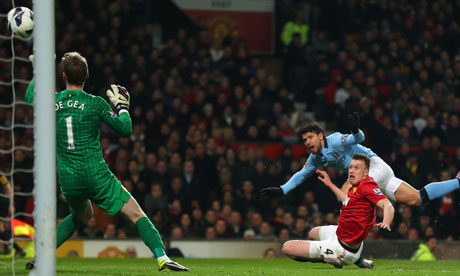
Perhaps it was because there was nothing to fight for but pride; maybe it helped that Van Persil left his shooting boots at home and Roo (ha!) had a mare. It could have been any of those things, but in the end we easily deserved the glorious win that marked two consecutive away beatings of the old enemy. Another incredible goal from Kun to seal it, and an overall performance which showed few of the cracks and failings we have displayed in some of our worst matches this season. Nastasic looking solid, Clichy full of running, Vinnie back to his self-assured best, Yaya strong and powerful - playing a captain's role on the occasions when football was secondary to handbags - and Milner getting MOTM as he deservedly should have. Merlin not quite clicking as we know he can, but still more than bloody decent, and Nasri playing... well... OK, I suppose. Then it was all nicely capped off with the #tweetyourphiljonesface hilarity the next morning, once again confirming City fans as the wittiest in the country.

On to Chelsea then, and in the purest sense, the football gods you might say would demand a sacrifice, but the victory at the Sty was purely on merit, and I can say with my hand on my heart that we bossed the fuckers for pretty much the whole 96 or 97 minutes. Even their goal was ridiculous, down to a crazy Joe Hart lunge and a bounce off Jones' beaker mug onto the back of Vinnie's shirt before somehow going in. We all know that Bobby and Platty are right when they say that the title race is over, but we can dream. A small glimmer of hope to brighten this interminable winter with its persistent easterly wind gnawing at our bones.

Though they do say spring is on its way, with a possible 21 degrees at Wembley to look forward to tomorrow, and what promises to be a testing game against the Smilers. Could go either way that one (I'm not ashamed of the cliche, thank you) but it does look likely to have its moments. Mata, Hazard and Oscar are all deadly on their day, while Ba can bang them in, and even old Frankie Lamps is still a man to cause any team problems. But they are, if not a curate's egg (which is becoming one of my favourite phrases - typically slippery English) then certainly a curious bunch this season, Benitez's boys: full of flair and brio one minute and clod-hopping losers the next. On top of that, it is the FA Cup of course, and the accepted wisdom is that accepted wisdom goes flying out of the window. All I can say is that I'm looking forward to it. Sunday 4 o'clock kick-off is an ideal match time for me.

Current reading: Stephen King's It. Not up to the standard of Gerald's Game or The Shining, but entertaining nevertheless. King can write about childhood like nobody else, but It seems a little too unfocussed to hold the terror of - for example - the Overlook Hotel. I've had quite an exclusive diet of the Maine man lately, but I'll stick with It for the time being. I feel I can't flush Stephen out of my system till I get hold of a copy of Pet Sematary. Then I will move on to someone or something else.

Current listening: I've Been Everywhere, Man by Johnny Cash. What a tune! I'm trying to:

a) learn the words and

b) come up with an Oswestry version (having found that there's a Kiwi one, FFS!) even though Maesbury doesn't have quite the same ring as Sioux City.


Current work situation: being called a fucking wanker by some weirdo who spends his time ringing us up and complaining about... what? I don't know. I was rattled the first time it happened, but now everyone is surprised at how clamly I deal with him.

Sunday, 24 February 2013

Oligarchs


My thoughts on the Pistorius/Steenkamp case (as everyone seems to feel the need to express these) are that the whole tragic case has only been compounded by the astonishing way in which every detail of it is being broadcast - almost in real time. No good can come of this prurient desire to splash every morsel of information over every media outlet in the world, and it is depressing in the extreme. That's that.

So next up Chelsea again, shunted aside to a lunchtime kick-off by the ridiculous display of the Capital One cup final (seriously - and I am a football fan let me tell you - who but followers of Bradford and Swansea can be looking forward to that?) The boys from the Bridge are hardly an ideal team to face at such a critical juncture. A few seasons ago, I would have feared the worst; the season before and the one just gone, the tone would have been a good deal more optimistic; this time, it could go either way. They are still a good side, despite their recent minor fall from grace (which is actually only a part of the decline in English Premier League football in comparison to say Italian or German sides - in the Champions League, that is) and capable of giving any opponent a game. Amazingly, Torres continues to endure the purgatory of being Roman's golden boy, but I feel despite the seemingly endless toil and humiliation that he will always carry a threat. In Hazard and Oscar they have two fantastic players, and of course fabulous Frankie Lampard is banging them in to try and reach that record before he heads off to Kazakhstan, or China, or wherever the hell they send them these days. Cech looks a lot weaker than he has ever done, but is nonetheless big and strong with a scary hat on. For us, Tevez ought to be buoyed by some good performances and his goal against Leeds, Kun is hot hot hot, and Vinnie looks as if he may make it back from his calf (or is it foal?) injury. So, hard to predict the outcome of this one. I will say 2-1 City, though fear it could be a draw or even the reverse of that scoreline.

For some reason, I thought the Rags would be playing the second leg of their Madrid tie during the week, but of course they've changed the setup once more, and it's on next week. Zzzzz. They face the Hoops at Shepherd's Bush, most likely without pube head, but that shouldn't make much difference, and I fully expect them to run away with it there 1-0. All of which means we will probably have to pedal like hell just to stand still. But hey - there's pride if nothing else to play for.

Further to my last update, I've just finished Stephen King's On Writing (I also came across a review [well, sort of a review] of Pet Sematary today, and now I feel I must read that one. As my Isness said, it would almost be possible to read nothing but Stephen King) which I've been meaning to read for a while now. Worth the wait, and it's set me to thinking a little about 'the craft' and my place in it. I'm going to take on Stephen's challenge in the book, and aim to produce the fruits of my labour in the final post on this blog. I will say no more on that subject because the door must remain firmly shut.

Friday, 14 December 2012

Long Live the King

I know I've mentioned him before, and I apologise for the repetition, but he's got into my head again. The latest compulsion is a book called Gerald's Game, a nasty yet absorbing piece about a woman who ends up (where else?) in a deserted holiday home in the Maine woods - handcuffed to a bed - while her husband lies dead at her feet. In fact, the eponymous husband is slain by those very feet when he fails to read his wife's stop signals clearly enough.

As always, there's no messing around with Mr King. He's straight into the action and does not stop all the way along (though I haven't yet finished) barely pausing for breath as he goes. Aside from what I think are the book's fascinating themes of sex and sexual abuse, self-loathing and fear, there is the writer's courage at being able to examine in microscopic detail the very worst of human nature we can possibly imagine. And we can possibly imagine quite a lot, unfortunately. There are, it is true, real instances of child abuse, and perhaps also real instances of handcuffed women killing their husbands when bondage games go wrong. However, the ability to take these events and write them down on a page surely requires an unflinching resolve, a firm grasp of one's natural revulsion to persist with accurately (some might say a little salaciously in King's case, perhaps. Though this book is somewhat less fantastical than many of his others, there is still almost a sense of his revelling in the gore and dark stuff) portraying them. Anyone who does not harbour sexual feelings towards minors would surely find it difficult to write down such an episode? Whatever the case, it's a rare book indeed that causes me to gasp on the bus, or to unwittingly cover my mouth with my hand at the horror on the page, and must be praised for that alone.

In the meantime, thoughts turn to the Geordies and the question of whether Bobby will keep his job or not at the Sports Direct.com Stadium/St. James's Park. Certainly I think the stuffing was knocked out of us during last weekend's fiasco, and we need to make a firm statement of our intent. Whether we can or not is moot. Newcastle are looking pretty shaky at the moment it's true, but they still have some dangerous players, and there's no way we can sit on our laurels. I'm opting for 2-1 City, though hoping for a few more in our favour. Howay the Blues!

Wednesday, 10 October 2012

Wells Wells Wells


It started with The Time Machine, which I downloaded as an iBook. Shamefully, I realised that I hadn't really read any of HG Wells' prodigious and tremendous output, fixed firmly as they are in the imagination of Great Britain and the world, along with Gulliver, Robinson Crusoe and a Bear of Very Little Brain. So I thought I would give The Time Machine a go, expecting perhaps a boy's own adventure story. Sort of familiar with the Morlocks and Eloi and (truthfully) very little else in the tale, I was pleasantly surprised by the poetic, metaphysical course chosen by Wells in his imagining of our Restaurant at the End of the Universe, and - like all good books - it sparked off more questions than answers when I had finished it.

So it was on to War of The Worlds. Yet another story we believe we know so well, but which again I had never read, though of course it lurks in the memory from the days of BBC2 horror movies, the recent (I'm sure) dreadful film with Tom Cruise, and the Orson Welles radio thing. This book is a thrilling, rollicking romp, sweeping from Crawley on through the entire universe and taking in politics and philosophy along with the requisite adventure and science. I found the soldier particularly fascinating, with his revolutionary ideas and his expositions on the frailty of the human character, while the poignant isolation of the narrator after the affair struck a chord for a man like myself about to enter his sixth decade. Great stuff.


By now I had been bitten by the Wells bug, and moved swiftly on to The Invisible Man - another tale so deeply ingrained in our consciousness that there was even a TV series made out of it with David McCallum, and yet the original tale was unknown to me. It is a remarkable read, betraying perhaps its embryonic episodic release in pamphlet form with noticeably abrupt (though ultimately, this adds to the power of the work, rather than diminishing it, as if the very shock of the changes deepens the experience) switches of style: from slapstick humour to shocking violence, to melancholy philosophical treatise. The laughs are real laughs, the violence truly violent, and the philosophy deep and meaningful. All of this told in short, breathless chapters which drive the action relentlessly on, page by page by page. The ending intensely evokes a sense of sombre thoughtfulness - musings on our place in a cold, lonely and infinite universe. Not to mention of course the place of the Invisible Man in City's pantheon of fabulous chants.


The Invisible Man led me to read a little about the author himself, and I was then even more intrigued. It's worth looking up his Wikipedia page to find out more, but he led an extraordinary private life alongside his enormous written output, and was a visionary socialist thinker (I know, I know. Everyone was racist then. And a eugenicist) in tandem with his visionary scientific explorations. So it was that I visited the library, and there took out The Island of Dr Moreau, maybe not quite as fixed in the imagination as the Time Machine, War of The Worlds or The Invisible Man, yet still famous enough I guess, and certainly very well known by fans of science fiction. This was a venture even deeper into the mysteries of human existence, a treatise on god and man and civilisation set - in the best Defoe/Stephenson tradition - on a remote Pacific island. A superb work, where the reader feels transformed almost as much as the narrator by the end, and where surely Maurice Sendak took much of his inspiration for Where The Wild Things Are. The creatures and themes of the book still echo in my mind, some two weeks after finishing it.

My next (and current) book of Wells is The Shape Of Things to Come, which is so far the least familiar of any I've yet read, though it is not obscure, and I remember some pastiches or adverts from years ago. It is, up to the point I've reached so far, a real exploration of history, of the insanity of the economic model, clearly influenced strongly by the horrors of the Great War, and the need to create something meaningful and optimistic out of the carnage of 1914-18. There is a telling swipe at Winston Churchill:

"He displays a vigorous naive puerility that still gives his story an atoning charm. He has the insensitiveness of a child of thirteen. His soldiers are toy soldiers and he loves to knock over a whole row of them."

But, more than this, his critique of the Great War, and of the economic circumstances which brought it into being, which nurtured it through the terrible years of conflict and beyond, is searing. There are many parallels with the insanity of our current situation, a lesson from the past pretending to be from the future, which feels as prophetic as if it actually were written many years hence:

"With difficulty will the student let down his mind into the fantastic world of extinct imaginations in which these strange personifications, as monstrous and incredible as the ancient gods of India, were treated as real and morally responsible individuals, hated, trusted, feared and loved. The war was, in immediate fact, an aimless and fruitless slaughter upon the altars of these stupendous deities, the wounding and mutilation of perhaps twenty million human beings, and a vast burning-up of material wealth. In the crazy fancy of our ancestors it was a noble and significant struggle."

Monday, 9 July 2012

Magic journalism


I have been reading Kapusczinski again. A perfect combination for me, the reportage and lyricism, recalling times of which I had not previously been aware. Names like Ben Bella and Lumumba; conflicts in emerging liberated African states, from the far south to the Saharan north; unexpected similarities between the Polish and South American sensibilities; stories of a world forever lost, yet depressingly familiar in its casual brutality. I think everyone should read his books - should be transported to those far off places, recalling the intrepid foreign correspondent's life. Instantly accessible, yet diving to hidden depths with every sentence.

I started with his book about Selassie, and then after a longish gap read the one about the Shah of Iran. Now, I am near the end of The Soccer War (though this is only one small chapter, and perhaps misleading. There is far more about the Congo and Algeria than there is about the famous conflict which it seems was only a football war by pretext. But then, aren't most wars started and continued on a pretext anyway?) and am rapt to the final pages, clinging on and reading slowly because I do not want to say goodbye to this unique voice. I want him to stay a while longer, want to keep my eyes closed and blot out the mundane reality of the bus and the office, Murray at Wimbledon and the fucking Olympics.

His Wikipedia entry is full of that dense Polish intellectualism, tortured sentences spiralling around some erudite theme, accusing him by proxy of fabrication, fabulism and philandering. But what do I care for that? Anyone who can transport me so beautifully to such other worlds will always have a place in my heart, whether his words are 'true' or not. His star will forever burn bright.

Thursday, 28 June 2012

Back to it


All the frantic rushing around to reach 500 posts is now out of the way, and many thanks to Don Cake for his contributions. If he's willing, I would love to collaborate more with him on future spewings. Let's hope so. Maybe a joint writing project, who knows?


So it's back to the grind now, trotting out glib generalisations as I wend my merry-ish way through this thing called life.

Apart from the lingering melancholy over the Euros drawing to a conclusion, and the depressing inevitability of England's poor play (I'm glad that many I've spoken to agree with me that Roy was a victim of player power in not bringing Rooney off) I am of course dumbfounded on an almost daily basis by the increasingly bizarre behaviour of the Coalition. Having just today finished the monumental Under the Dome by Stephen King, I can't help but draw comparisons between the insanity visited on a small town by a cataclysmic event over which the inhabitants have no control as described in the book, and the terrifying, slow, disorderly disintegration of the current world order caused by the financial crisis.

In short, and without wishing to issue any spoilers, the people in the town of Chester's Mill, Maine, in King's book become trapped under an impenetrable glass dome (King says that he had not seen the Simpsons Movie when he wrote the book, and I have no reason to doubt him. In any case, there are significant differences in both plot and tone) and the town slowly descends into anarchy and madness. King has said that the book is a commentary, or wide-ranging metaphor, for the mass hysteria in the US and around the world engendered by the 9-11 bombings, but it can be quite easily extended in my view to encompass the entire world as we now know it. The main difference really is that - even though a psychotic leader - Big Jim Rennie in Under the Dome is at least a leader. Which is more than can be said for the current bunch of losers.

What I like about King (and many decry him as too populist - a view with which I disagree. I don't tell those who sneer at me reading his books that I have also read parts of Finnegan's Wake) is that he stands up for the underdog. He doesn't like bullies, and they usually get what's coming to them, even if they do cause quite a bit of mayhem on the way. And of course, he has recently stood up against the Neocon loons by asking to be appropriately taxed. Amusingly, UTD has been described - due to its sheer size - as a quarter of a Proust, and I think that is how all books should now be measured. Lord of The Rings? Half a Proust. The Prophet? A sixty-fourth of a Proust. I love it.

Thursday, 16 February 2012

Pass the Porto

This blog will be five years old in June, and I am around 35 posts away from a total of 500, so expect a few short and potentially rubbish pieces in the coming months as I strive to keep up with my number superstitions and coincide the two.

Thanks to the rather hysterical nature of the security services in this country, which could have resulted at the very least in a Dooce, and possibly even worse, I have chickened out of a piece on Abu Qatada, which remains on draft. I will instead step on the safer ground of the Europa League, whilst studiously avoiding any mention of that C----- T----.

After an ultimately satisfactory if not entirely satisfying victory at Villa Park, thoughts must now turn to the utterly pointless and seemingly endless slog of the inferior European club competition. I don't know much about Porto, other than that they have been among the best Portuguese teams for some time, although the once great heights of clubs in that country have not been reached in recent years, so their title win - albeit by a margin of 21 points - last season (wonder if AVB wishes he had stayed on there now?) can perhaps be taken with a small pinch of sodium chloride, though they did of course win the bloody Europa Cup as well. Hulk is there to smash and they have Maicon and Danilo. It's a tough one to call, and I don't expect it to be an easy game, though it may be suited to the style of Merlin. Looks unlikely that Yaya will get a run out, which is a shame, and let's hope Mario doesn't blow it again. It's on ITV in any case, so that's got to be good.

I've started reading Notes on a Scandal by Zöe Heller and, although the style initially put me off, I'm now beginning to enjoy it. In the early chapters, Heller mentions Kit Kat by name and then goes on to refer to 'instant noodles in plastic pots'. Why couldn't she just say Pot Noodles? But there is some redemption in the use of the word 'gelid' in chapter 5, and I'm enjoying (in a purely literary way, you understand) the sexual frisson of the teacher's affair with the adolescent boy. It's made me think of myself as a 15 year old, and made me realise how very unappealing I undoubtedly would have been for any bored pottery teacher, especially one who looked like Cate Blanchett. Ah well.

Friday, 13 January 2012

Roots II


Having made my way through the book a little further, I feel bad about my last post on Alex Haley's Roots. It's as if I didn't give the piece enough kudos somehow, did not appreciate the massive cultural impact the work must have had. This is proving to be a searing read, and my somewhat flippant attitude was shaped by the fact that I had previously only watched the TV series. What I am beginning to realise from reading the text, as well as some of the background to it, is that the story carries an enormous weight - especially for black Americans - and that it is written with great power. I still don't know which sequences were plagiarised from Harold Courlander, but will try to get hold of a copy of The African to find out.

Be that as it may, the sequences on the slave ship are viscerally 'honest', if that's the right word, unflinching in their portrayal of the squalor and utter brutality visited on the poor people aboard by the barbaric 'toubob'. How any human being could have survived such a terrible journey: four and a half months in the hold, chained to boards 24 hours a day, rolling in their own piss and shit, covered with sores and infested with parasites, beaten and whipped, is truly beyond me. Haley writes with great pride in the inner strength and dignity of the African men and women torn from their homeland to be sold as free labour in the not so brave New World. By describing the ship as a giant canoe, a cannon as a great black stick, and other similar devices, we see what is happening through Kunta Kinte's eyes; his inability to fully comprehend what is happening to him giving the terrible events an almost supernatural power.

Importantly, there is no Ed Asner figure to soften the worse than hellish cruelty meted out by the crew. This particular addition to the character list, along with some others, was made by the Executives at ABC Television to please the watching white folks in middle America, and it is I feel a further shame that it was felt necessary to do so. Indeed, I have read that there were no real expectations for the programme when it was made, and that it was originally almost sneaked out for fear of turning off the core audience - or the core audience turning off. How wrong can you be?

I also felt that there might have been a racist interpretation to some of the things I said in my previous post (specifically the bit about doing Kunta Kinte and Chicken George impressions) and I would like to quash that here. I would say that my younger self - like Richard Herring's - was a racist. We knew little of the world in Oswestry, and many - if not all - were, I'm afraid to say, surrounded by racist attitudes. Remember that Love Thy Neighbour and Mind Your Language were staple fare for us also, and so (excruciating as it now is to remember it) capering around shouting 'Don't whup me massa!' was considered the height of sophisticated humour for a 13 year-old boy.

Did watching Roots make me consider my racist attitudes in any way? In all honesty, I don't think it did. Just about everyone loved the programme. It was a cracking adventure with some boobs in it, but I really don't remember contemplating the role of the British and Americans in slavery to any degree. Reading Roots now is certainly making me do that; from my position as a middle-aged man, I can more clearly empathise with the human suffering portrayed, and can more fully comprehend how the whole thing must make black people feel. Especially as some things just haven't changed. Alex Haley must be given great praise for what he did, and I would urge you all to read this book.

Wednesday, 11 January 2012

Zippin up my Roots

I've just picked up a copy of Alex Haley's Roots from the library. It's a good read, and once I started getting into it, memories of the TV series came flooding back (I once visited the outdoor set at Golden Oaks ranch in California, where some of the sequences in Roots II were shot, and my word, how evocative and amazing was that, even though Roots II was crap compared to Roots?) and I became curious around the subject. Intriguing that this partly phony exploration of a man's personal history should cause a refelction on my own. I think it must have been 1976 or 1977 when the programme was on TV, and I was in the early years of my secondary education. Every Monday would entail a ritual Kunta Kinte or Chicken George impression among those of us at Oswestry Boys High School. My own family tree stops dead on my mother's side (a little further back on my dad's side - as far as a housemaid in rural Kent - about 4 generations before my dad) just before my great grandmother, thanks to some, shall we say, extra-marital issues, so how incredible, I thought, for this guy to be able to trace his family history so far back (to mid 18th Century Gambia, in case you were unaware and interesed) and I admit I wondered how it was done.

Well of course it turns out that he not only didn't actually trace his (whole) family tree, but more than that, he stole large chunks of the book from someone else's novel. What a crock! Harold Courlander (for it was he from whom the work was nicked) seems a fascinating character, responsible for some invaluable research into oral traditions in Africa, North America and elsewhere. Harold received an out of court settlement for the admitted plagiarism, though may have been wiser - given the huge success of the franchise - to have taken his case all the way. He probably didn't receive as much as he could have (the information in the Roots link above seems to say that the settlement was around $650,000, in 1978) through a rights deal, but also the fame associated with such a seminal piece of work lies solely with Mr Haley. Anyway, having just passed the circumcision scene, I will continue with the book and hunt out the series on YouTube or elsewhere, while fomenting my own imagined youthful adventures among the arafangs of Oswestry town.

All of which brings me to footballing roots, and a remark made on Sunday while I was in the corner shop at the same time (oh happy chance!) as a Rag, shortly after the match had finished. "You don't sound as if you're from Manchester...?" he said, gauntly, and I replied: "No, I'm not." Whatever the rights and wrongs of the Kompany red card, I think the time has well passed for City fans to get over it. We don't want to end up looking like sour grapes Scousers bemoaning our fate, especially as everyone knows we've got tons and tons of cash and about 600 players out on loan. I personally think we should take great comfort in our performance, reflect on what was an excellent match and get on with playing Liverpool. Again. And again. And again.

Saturday, 19 November 2011

Cave In


After the seriousness of last week's post, I've now managed to draw breath and prepare for the next thrilling instalment. This year, as part of my attempt to free myself from the tyranny of writing, I've decided against the usual December thing of writing 12 posts about some or other theme, so I don't feel under any particular pressure. In previous years, I would have needed to have completed 88 posts by now so that I was ready for the December dozen and could complete my annual haul of 100 posts. But not any more. I still can't get over a slight feeling of unease however, as I have only managed something like 50 this year. And it hasn't been a particularly busy one for me. Positive in many ways, and certainly with some major changes in my life, but not busy.

So I have the luxury of thinking about (at long fucking last. I'm sick of seeing John Terry's mug on the back page of every paper, bored shitless by watching England against Sweden, and gobsmacked by that idiot Blatter) some proper football before I head off to Shropshire for a few days next week.

What to say about the Geordies? I always did like them, partly as a result (and this may not make sense. To clarify, I felt no specific sense of pride for Sunderland, despite living there, although it did - and does - mean that I paid attention to their results a bit more closely) of spending so much time in Sunderland. Newcastle is about 25 minutes by train from Sunderland, and I used to visit regularly, having exhausted the delights of Binns and the Royalty after about 10 minutes. It (Newcastle) is a great city; very vibrant, despite the many knocks it has taken - and continues to take - in recent years. The club also has a tremendous history, a wonderful fan base and a place firmly cemented in any true (with the exception of the Mackems, of course) football fans' hearts. Of course, like the city in which they ply their trade, the recent past has not been kind to the great institution, with the latest decision to rename the ground as the Sports Direct Stadium a further mortifying insult heaped on it by that villain of the piece, Mike Ashley.

Alan Pardew has never been a favourite of mine, and didn't really seem to demonstrate that much greatness in his previous jobs. The squad has been decimated for financial reasons, and relegation - to me at least - seemed a definite possibility for the Magpies at the beginning of the season. But, despite all this, they are the only unbeaten side in the league apart from the mighty MCFC, and they appear to be going from strength to strength. Why should this be? David Pleat's chalkboard and endless footy opinion pieces don't provide satisfactory answers for me, and I think it's all down to... blooming luck! Let's face it.

Buoyed up by our recent encouraging financial figures, we will surely be too much for the boys in black and white. I don't expect a goalfest, but we should win it by the odd one. Let's see.

This week, Alan has been reading The Death of Bunny Munroe by Nick Cave. Though he found it interesting, it was ultimately unsatisfying, so he put it down unfinished.

Monday, 3 October 2011

Carreg Llwyd


Piss off Pearson

Just starting Owen Jones' Chavs - The Demonisation of the Working Class, and it's made me think (once again) about the issue of class in this loose affiliation sometimes referred to as a nation. The first chapter deals with the disappearances of Madeleine McCann and Shannon Matthews. Despite - or perhaps because of - the very different ways in which these stories ultimately panned out - it is very revealing when you actually think about it. The screeching nonsense of Carole Malone and Allison Pearson  are only to be expected, but it was excruciating to read India Knight's comments about the Dewsbury Moor family. Oh, I know she writes unreadable bollocks for The Observer, and is sickeningly smug, but somehow I thought she was just a little bit better than that; a little less vitriolic and dismissive of her fellow human beings. I was wrong of course - despite the fact that she once responded to one of my tweets.

There can be no denying that (with the exception of Polly Toynbee and the recently disgraced Johann Hari) the chatterati all clearly felt that the Matthews family, along with their neighbours, were markedly less deserving of the milk of human kindness than the shiny, professional McCanns. Ever the opportunists, both Cam's crew and the NuLab boys all latched on to the bathetically tragic story of Shannon to reinforce the 'undeserving poor' dialectic which is proving to be so dangerously effective at present.

I was raised on a council estate. My grandmother was a cleaner and my mother a barmaid. My father drove lorries for a living. Nights out were working men's clubs, bingo and thick smoke, cheese & onion crisps and blackcurrant squash. My diet was heavy on offal and potatoes (though I never tried a jacket spud till I was 10 years old) and tea with lots of sugar. Dripping butties were a frequent treat, and my uncles did the pools every Saturday. These days, having attained my university (well, Poly anyway... And all right, it was at Sunderland, but still...) education, and despite living at or just beyond my means, I still choose Waitrose over Lidl (and often over Morrison's) and I eat bruschetta. I listen to opera (occasionally) and prefer BBC4 to ITV1. I'm paid monthly, and struggle just as much as any 'undeserving' benefit-sucking family would when week 3 comes around, though none of my hard-earned wedge goes on mortgage payments. I realise through reading Chavs that I have been guilty of mocking a large section of society, as well as my own heritage, and hang my head in shame. It was perhaps my very closeness to the working classes which gave me the feeling that I could do so, but there really is no excuse.

Footballers of course are paid weekly, regardless that the pay packets of even the modestly well remunerated ones are roughly four times the annual median wage, and it is really very odd that this vestigial link to the days of miners' sons tramping off the cobbles and on to the pitch remains. Substitute cobbles for favelas or African villages, and we have a sign of the times.


I'm not sure how one would categorise Mario Balotelli in terms of social class, because I know little about Italian society and less about Ghanian, but there are occasions when his football class comes to the fore, and I for one am glad that he has chosen this moment to produce the goods. The defeat at Munich could quite easily have marked a downturn in our fortunes, the top of a slippery slope from which arresting the slide could have proved difficult. Luckily, Blackburn are truly shit this season, and that's saying something.

Wednesday, 20 July 2011

Falling Apart


Image courtesy of Wikimedia Commons - uploaded (as far as I can tell) by someone called Patrick Gijsbers in 2007

It's all falling apart, isn't it?

Just finished William Leith's book of a similar name, and he really says it all, writing as he was from the viewpoint of a man only a year older than I am. Ironically, given that its theme is (partly at least) decrepitude, I took the book to the park with the kids at the weekend (intending to read it a little later on the bus, just in case you might think I would read in the park with the kids. Perish the thought! I actually played cricket with them. And won, as it happens) and ended up leaving it on a bench there, not realising until we had walked the 15 minutes or so up to the high road. If it hadn't have been a library book, I might well have left it lying where it was, but I didn't want the hassle or expense of buying a new one.

So I deposited the kids in McDonald's with milkshakes and started to lope/jog back down to the park, feeling fairly confident that the book would not have been half-inched in the meantime - due mostly to the inclement weather. William Leith says he could probably run half a mile if pushed, and I guess that the 15 minute walk (I feel I must debunk the old chestnut of walking speed being 4mph, especially when there are two kids walking with you) would be equal to about that. Let's just say that, though I wasn't suitably dressed for running, I didn't actually manage to make it all the way to the park before running out of puff. Since then, I have been feeling rather old, what with the lump on my foot and a pain in the kidneys; perennially blocked sinuses; occasional toilet problems, etc...

Though rather frightening, and sadly looking to be always topical, the other theme of interest in the book is the state of the global economy. Leith uses the cod as an analogy of the way in which our system is doomed to certain failure. Cod - he says - have a survival strategy of, well, just getting really big. This works pretty well in the prime of their lives as their sheer magnitude protects them from most predators (humans - as always - excepted) and they grow quickly to become fierce hunters of the sea. In the end, though, their size works against them, causing them to become unable to survive. Or something. This mirrors the edifice of global capitalism, which continues to rush into its own destruction in pell-mell fashion. Style of thing. In any case, I was seduced by the argument, like Winston Smith I suppose, enjoying most the books which tell me what I already know. It is self-evident - despite the profit announced by Apple - that year-on-year growth is simply not achievable, and the flimsy facade of promises looks perilously close to crashing down on all our heads. This argument is given added resonance of course because of the decimation of cod stocks across the world.

With the United States on the brink of being unable to pay its soldiers, with countries like Italy and Spain all but financially collapsed, with the UK establishment daily being further exposed as a stinking cess-pit of corruption and cronyism, it will be a wonder if we make it through to August 7th and the Community Shield, where Agűero will probably line up alongside Tevez and JÔ's name will not be on the team sheet.

Tuesday, 12 July 2011

My Self


Realising that I have far too much Will Self in my book collection, I nonetheless embarked on The Butt  recently. Not one of his best (he can be patchy, though I love the best - Great Apes, for example. Or The Book of Dave, whilst I found Liver a bit of a drag) it is nonetheless redolent of Graham Greene - it even has an Honorary Consul, as well as plenty of sweaty hat brims - and JG Ballard, creating a dystopian, nightmarish land (Australia? Not quite. Which is odd) with ridiculous, overblown laws and customs, and strangers who bear uncanny resemblances to family members. Yet it is somewhat rambling; does not hold the attention well enough, does not have the same terrifying believablilty of Ballard at his best, the same depth of feeling of Greene at his best, and fails - I would venture to suggest - to strike the right balance of black humour and terror. Needless to say, there is also the obligatory over-use of the thesaurus. Far be it from me to pejoratively cast anyone as 'brainy' for using big words. Heaven knows, I used to go through back issues of the Reader's Digest like a whirling Dervish looking for the 'It Pays To Improve Your Wordpower' section. But still, there's a slight clunkiness about the sprinkling of 'empurplement' and 'ever-ramifying' throughout the text which - I daresay - lessens the narrative power of the tale.

The most unsatisfying aspect of the novel by far though is Self's decision to take on an American voice in his main character, the anti-hero Tom. Will is nothing if not quintessentially English, and I feel that the device (of having Tom come from the USA) in order to contrast the power of this nation with the faded and pathetic post-colonial England as emodied by Prentice hardly seems worth it. Tom does not come across as a real American, despite Self having him use words like 'mall' and 'buddy' and one squirms a little on these occasions, it has to be said. Maybe it wouldn't have been possible for an Englishman to have had the limitless credit facilities which Tom seems able to draw on or some other such consideration, but I must register my protest.

Nonetheless, I wouldn't wish to suggest that this is a gimcrack book. There are some excellent sequences, and Self frequently captures the moment in a few choice words (particularly his descriptions of off-season tourist locales - sad, jaded and corrupt. Wonderful) and there are occasions when - sweltering on the 329 bus as it crawls up Green Lanes with its mad cargo of London folk - like the buildings - thrust haphazardly against one another that I struggle to discern where the book ends and reality begins. An Asian girl chatters non-stop into her mobile phone, a family of fat kids stare intently across the aisle, a baby wails incessantly and the automated voice tells all that 'seats are available on the upper deck'.

Friday, 8 July 2011

Leaders


Two books have entered my consciousness recently, and there are - despite the initial appearance to the contrary perhaps - some interesting (IMHO) comparisons to be made between them. I had kind of planned to carry out a detailed comparative analysis on different sections of the two books, but that ain't gonna happen, so I'll stick to some high level, thematic stuff and just hope for the best.

Get on with it, for Christ's sake! All right then.

The first book is: White Line Fever, a semi-ghosted autobiography of Ian Fraser 'Lemmy' Kilmister - lead singer and bassist with Mötorhead, not to be confused with the 1975 trucker movie starring Jan-Michael Vincent - and the second: A Journey by the one and only Anthony Charles Lynton Blair, who of course needs no introduction at all. I must point out that I didn't manage to finish the latter, being as I was in danger of being physically sick over everyone on my tube carriage whilst reading it, though I breezed through White Line Fever in a couple of days, so my review will not be a complete one. Anyone who reads this blog at all will probably also be aware of my personal feelings towards Mr Blair and his ilk, so you can pretty much be sure of what you're going to get in terms of whether I like one or other of the two works. Now that that's out of the way, I'll press on with my critique, and thank you very much for listening.

Both Lemmy and Tony were - without question - leaders. Lemmy still is, touring and making decent dosh out of Mötorhead (despite my loathing of advertising sell-outs, I must admit that I really like the slow version of Ace of Spades which is currently being used on the Kronenbourg 1664 ad) from his base in Hollywood, while Tony dreams of taking back some of the limelight he so clearly dearly loved. Perhaps he will return as President of Europe, and - given the state of the bloody place it would probably be appropriate that he does - lording it over a decaying corpse with no mandate and no probate. In a funny kind of way, we can see how the thirst for leadership is a common drive in both men, giving their lives a strong sense of purpose. Needless to say though, this is pretty much it as far as similarities go, and they really couldn't be more different.

Blair, it seems plain, was shaped by his father, or at least his father's desire for 'betterment'. Everywhere in A Journey are references to the desire in people to make their lives better: once given a hand on to the ladder, they feel the need to climb it for themselves without further assistance. His father sowed this seed in the young Anthony, desperately seeking the company of local Tory bigwigs, so that he could 'get on' in life, sending his son to Fettes, etc. Tony's belief in this desire of ordinary people for advancement frames his brand of social democracy (whatever that actually means) and his break away from the traditional Left values of the party he took control of all those years ago.

Lemmy otoh had two fathers (one biological, who did a runner when Lemmy was three, and one step-father, who seems to have been something of a lovable rogue - in and out of nick every 5 minutes) neither of whom figure particularly large in forming him in later life, and he sketches their characters in just a few lines of White Line Fever. He is a man of few words, it has to be said, and this is plainest in his attitude towards death. There is no sentimentality involved, no modern concepts like 'closure' or 'reconciliation', just a couple of words, such as 'he was a good bloke' or 'he was a wanker'. This is in direct contrast to Tony B, who persists with his teary, swivel-eyed God bothering, nonsense all the way through, quoting his own mawkish words at length when talking about the death of his Australian preacher friend and mentor.

Another - perhaps more obvious - distinction between the two men can be found in their attitudes towards intoxicants. Lemmy is some sort of role model, I have to say, in that his blood is too toxic for any other human to tolerate, and his own body so poisoned by the years of excess that he himself cannot tolerate the blood of another human. He fails (like all sensible people) to comprehend the logic behind the drugs laws and makes a mockery of them in his anecdotes. Tony's attitudes are more reflective of the mainstream of course - despite the fact of his son's misadventures in the West End, and despite his admittance of guzzling too much booze in the early days of the New Labour project.

Anyway, in summary of my opinion towards these two books and these two men: I wish Lemmy had been prime minister and not Blair.

Saturday, 15 January 2011

Zen and the art of making TV programmes


With some interest, I was looking forward to the Zen series on BBC1 on Sunday nights. I have been a fan of the Michael Dibdin (dead these four years. How time flies...) books for quite a number of years, starting with either Cabal or Ratking (I can't remember which, but I think it might have been Ratking). In any case, and as a devotee of crime fiction, I thought the books were very fresh - readable yet cerebral enough; striking the right balance between the mundane and the suddenly terrifying; laced with a nicely understated dark humour, and usually formed around a well plotted and exciting crime story. Admittedly, not every Zen book held up quite as well, and Cosi Fan Tutti in particular was a bit of a stinker. I enjoyed though, most of Dibdin's non Aurelio Zen work as well, and was kind of looking forward (with that ever-present feeling of dread which bodes disappointment, about a book being made into a film or TV show) to the new series starting.

And then Rufus Sewell turned up on one of those Radio 4 shows that seems to meander along (Loose Ends, maybe? Or Broadcasting House) as a blatant bit of puff for Zen. What he was saying sounded fairly promising. At least, it seemed that he had read some of the source material, and he was keen not to overdo the Italian aspect - with the hand gestures and over the top accents. There was, it has to be said, a certain smugness about Rufus, but then he is an actor after all. So, my anticipation of the new series was slightly enhanced.

And the show was... OK I suppose. There were a few disappointments for me and a few irritations. Sewell was perhaps chief among these, as he hummed and mumbled his way through his lines and held overlong portnetous silences on the telephone. He comes across as being nervous of speaking, rather than just knowing when to hold his tongue. His griflriend is sexy enough, a pleasing bit of eye candy and clearly a hook for the gullible male viewer, but I became very annoyed with her accent. Judging by the boards on IMDb, I wasn't the only one. If everyone else (apart from Zen's mother - who is another major source of irritation for me) is speaking in an English accent, why does she say things like:

"Are we guing to ev an efferr?"

Finally, there was that bloke who turns up in so many bloody BBC dramas, usually as some senior Intelligence Officer or something. He has a voice like melting butter, does a lot of adverts, and can't act for toffee. Whatever his name is, he appeared as the villain of the piece, and from the moment I saw his face, I'd begun to lose faith in Zen. The second in the series was unfortunately worse than the first, and I found myself drifting away from the story before it ended.

I was somewhat pleased to read the Facebook status of a Jandrell acquaintance the day after which supported my critique.

Sunday, 27 December 2009

Damned good? Or Saint Thaddeus

Only two Apostles left, and only two posts before the end of 2009. My final post will be so good that it will need to be named twice, and will include the obligatory round-up of the year. Best wishes to Mancini. I love his music.

Podcast Episode 4 is now up. I thank yew.


St. Thaddeus is not the most tedious of all the Apostles, although very little seems to be known about him, and even his name is shrouded in the usual confusion. In common with many Jews (it seems) around the turn of the BC/AD thing, he may have been called Jude. Most interestingly, he is the patron saint of lost causes, and as such has no doubt been called on by many a football fan in moments of extremis. He is also the patron saint of Flamengo in Brazil.

One footballing icon who definitely would not have invoked this (or any other, given that the only thing he believed in was himself) saint, as I am currently finding out, is Brian Howard Clough. I was fortunate enough to receive both the book and the DVD of The Damned Utd over the festive season, and am rattling through the book at a fair lick right now. The blurb makes claims that the book is among the best ever written about sport.

I haven't finished it yet, but would struggle to contest this claim, marvellously enjoyable as I am finding it to read. It is a riveting subject, and pretty well written, though repetition is perhaps, er, over-used as a literary device. Additionally, repetition is perhaps, er, over-used as a literary device. However, there are few others I can think of which would compete, especially in the realm of fiction. I have enjoyed various biographies and autobiographies (Maradonna's stands out particularly) and many good books ON football, but this is right up there with fictional/historical sports writing. I can only hope that the movie matches it and is an improvement on Goal! although that would not be difficult. Middlesbrough??!! I ask you. That there is a Goal! 2 is something of a surprise.

Best wishes to all for the New Year, though I will return before the end of 09.

Tuesday, 24 March 2009

Following My Dick

With thanks to Blarg.net for the image. Which was probably stolen anyway...

Reluctant as I am to add to an already enormous pool of erudite comment about a great writer, my current library book is forcing me to say something. By use of the telepathic tendrils it has shot into my nervous system.

Of all the writers (SF or otherwise) I have read, the elusive and effulgent Philip K Dick possesses the rarest of abilities to surprise and confound at almost every sentence's beginning. I have read a great deal of his (and the word prolific doesn't do justice to the canon) work - both Iain and Iain M if you get my drift - and have been in love with most all of it. At the time and in retrospect.

At present, I am three quarters of the way through Flow My Tears The Policeman Said, and it feels (as it often does) that the writing starts to bleed into my life, in the same way that objective reality is always negotiable for the characters in Dick's books. We flit, with increasing unease, from the mundane to the drug-induced and back again, until we seriously begin to question our own sanity. Mostly because we can all too clearly identify with the un-anchored nature of our grip on this lunacy we pretend to be in control of every day. Slowly, we start to slip off, like the strings on Jimi's guitar, and a fight breaks out on the tube, and a lost person calls out too late for directions to Covent Garden...

I think it would be safe to say that Dick dabbled in psychotropic substances during his immensely complex and fruitful life, but was - crucially - able to write about his experiences with such terrifying clarity, humour and savagery. Anyone who has ever taken mushrooms or dropped a tab must squirm in their chair as they read some of the passages.

Now you'll have to excuse me as I have a date with a leather-clad bondage obsessed incestuous 6 foot tall twin sister skeleton who is lying on the bathroom floor. And I'm not sure if the mescaline has worn off. Cheers.

Saturday, 31 January 2009

Why I gave up on "White Teeth"

I became really irritated with it, and I could only finish it if I was locked in a cell. With no food. And a padlock on my zip.